

FASHION

There is a large variety of fashion within the Victorian era as a whole. Bell-shaped skirts, frills and bonnets gave way to more figure hugging styles from the 1870s.
Women’s magazines of the time, regardless of the content of the magazine, mentioned fashion often, specifically what was in style in a particular month. What was being worn by the court and in high society in London and Paris was reported on, creating a kind of aspirational uniform for women. Fashion remains central in women’s magazines even 200 years later, defining and providing a means to perform feminine identity.

1830s & 40s
1850s
1860s
1870s
1880s & 90s
"Fashion not only stressed the physical body. It was associated with an aristocracy and court notorious for sexual promiscuity"
- Margaret Beetham
1830s & 40s
The Regency era spanned across 1811 until 1837, the end of the Regency era and the beginning of the Victorian era had a common custom to change dress several times a day, specifically once in the late morning and another time before dinner. A low, almost off-the-shoulder neckline was dictated for evening and formal wear, whilst higher necklines and collars with small shawls were appropriate for daytime.
Cinched waistlines with a low point at the front of the dresses with wide bell-shaped skirts with puffy sleeves were the typical dress at the beginning of Victoria’s reign. This silhouette was created by undergarments; the skirts were supported by many petticoats with long corsets rounding the bust.
The corsets in this time were typically hand-sewn, using hardwearing cotton, with busks made of wood or metal. There were techniques, boning and cording, to offer additional support. Boning used whalebone, also known as baleen, as it was flexible while being supportive.
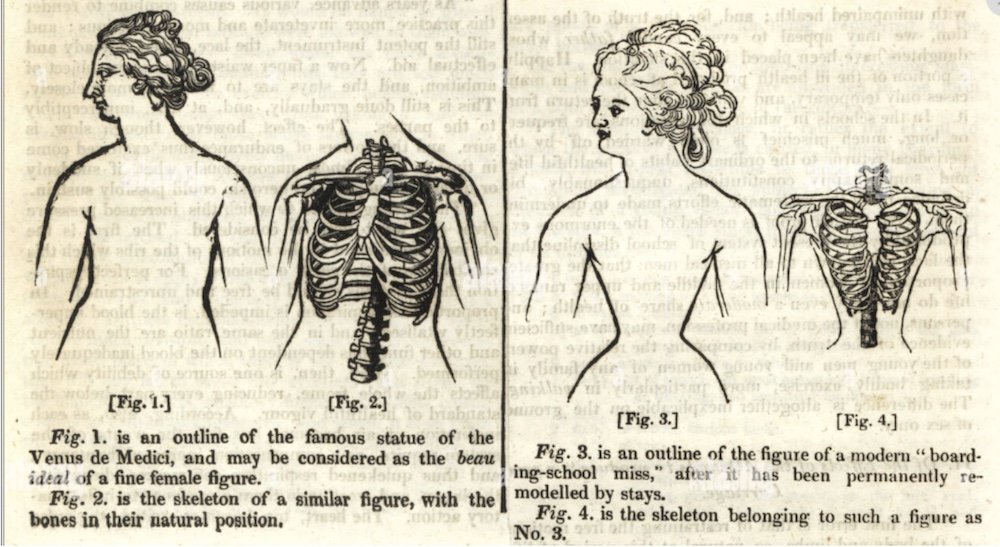
Corsets were also laced from the back using stays, which caused a lot of damage to women due to the tight tying of the corsets to gain the best figure for their dresses.
This image came from a woodblock engraving from The Penny Magazine, printed by William Clowes, Lambeth in 1833. It shows a comparison of the skeleton and body after the use of whalebone corsets and the permanent disfigurement that came from it.

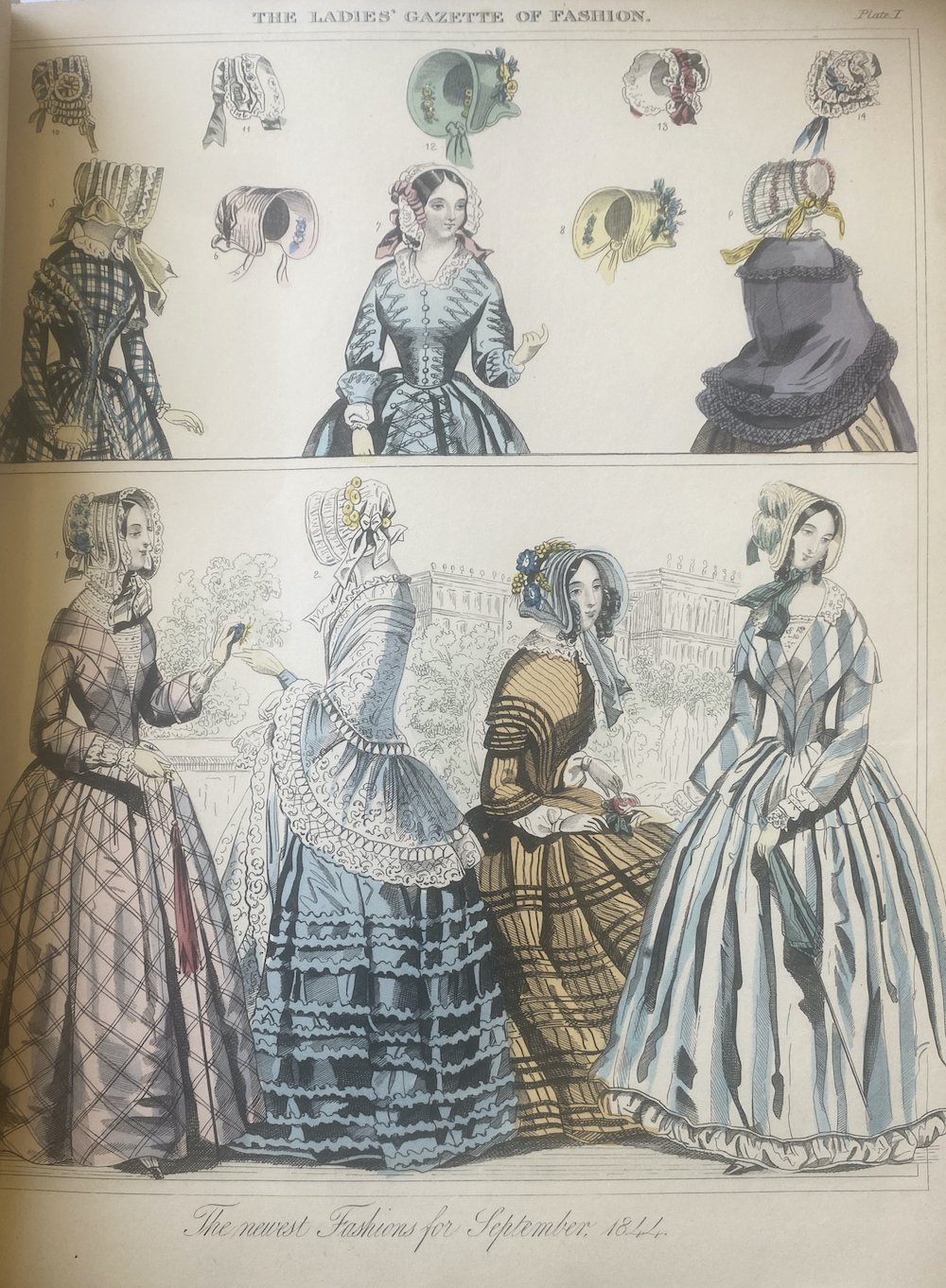
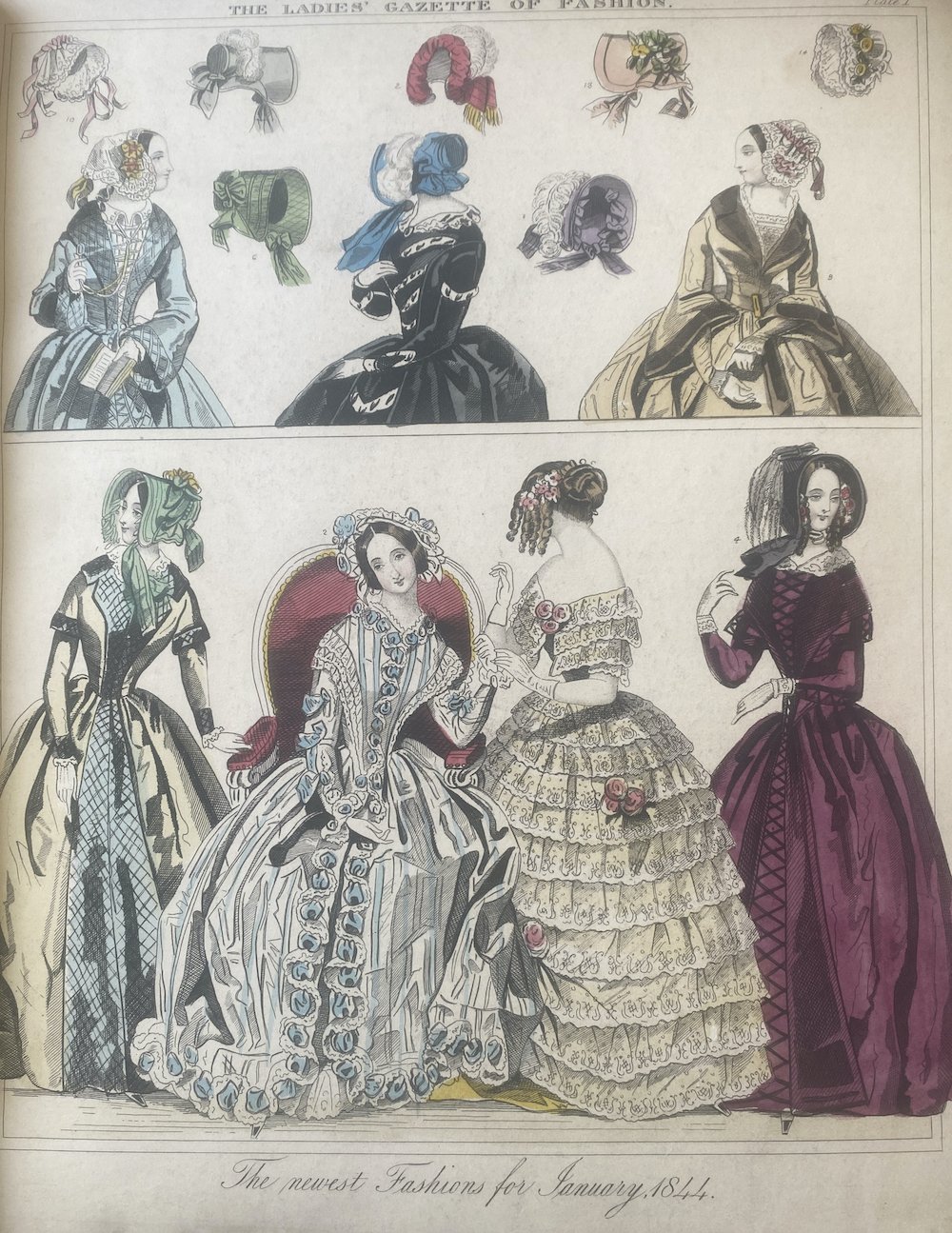
The Ladies’ Gazette of Fashion 1844
This image was in one of the earlier editions of the Ladies’ Gazette and presents typical evening or formal fashion for the month of January.
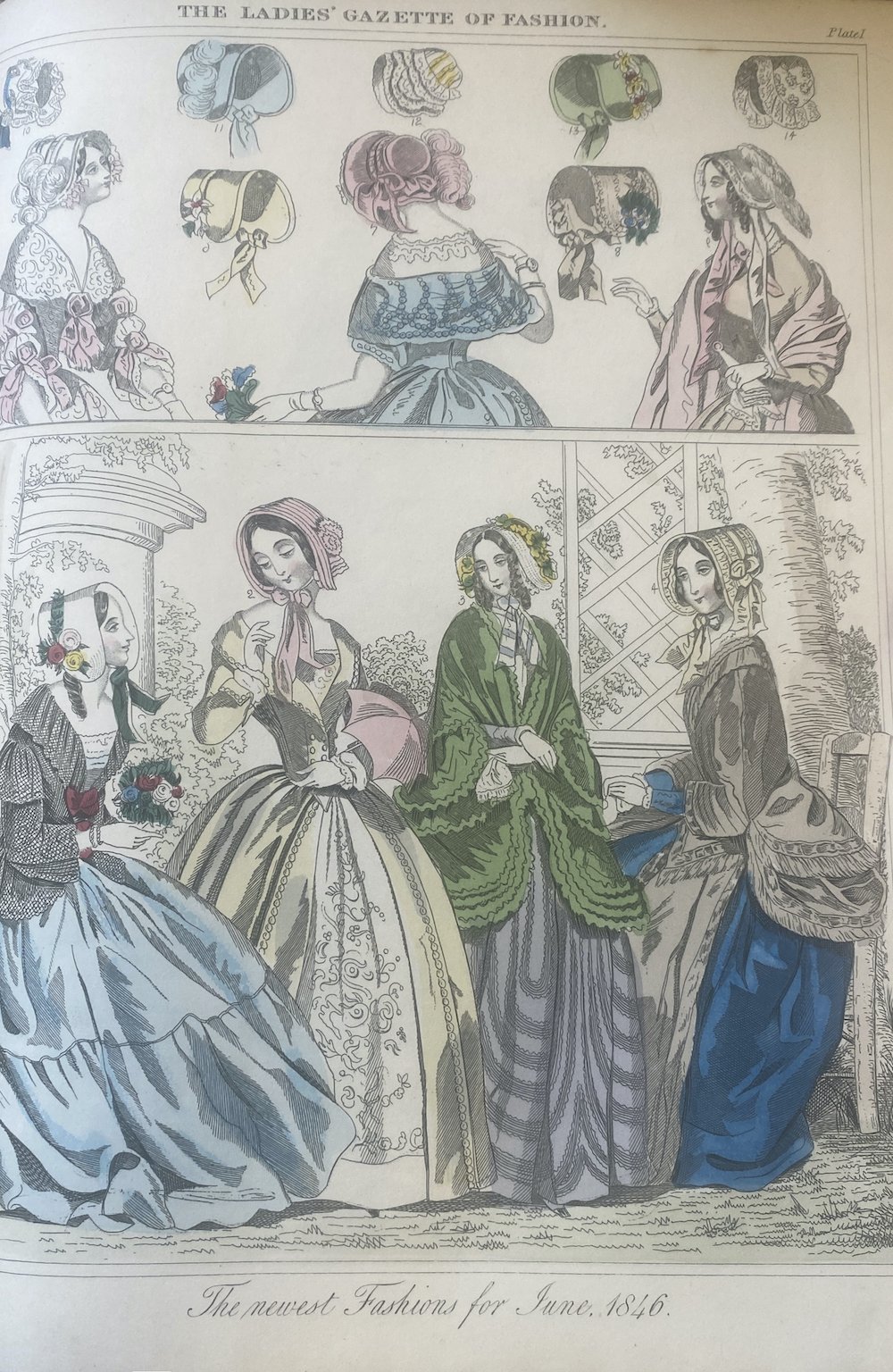
The shape of these dresses used corsets to cinch in the waists and hoop skirts helped to shape the dresses. The tighter sleeve look began in the 1840s from the puffier sleeve of the previous decade. These techniques aided the illusion of a smaller waist, along with the use of frills and ruffles on the neckline and skirt.
The Romantic Movement was in full swing during this decade, influencing the fashion of the time. For example, the small Elizabethan ruffs featured in magazines drew inspiration from this movement.
1850s
The fashion evolved dramatically in the 1850s due to more modern industrial innovations. The mass production of clothes was aided by sewing machines that allowed for a variety of clothes made at a quicker pace.
Skirts continued to widen and petticoats were no longer able to give the desired volume. Crinoline became an alternative in 1856. The crinoline cage was made up of metal hoops that got became wider towards the hem, though due to this structure, women had to learn how to walk and sit in them to remain ‘lady-like’ by not showing any ankles or under clothes.
Evening gowns in this decade had an even lower neckline, meaning it was either worn off the shoulders or just about on the shoulders.
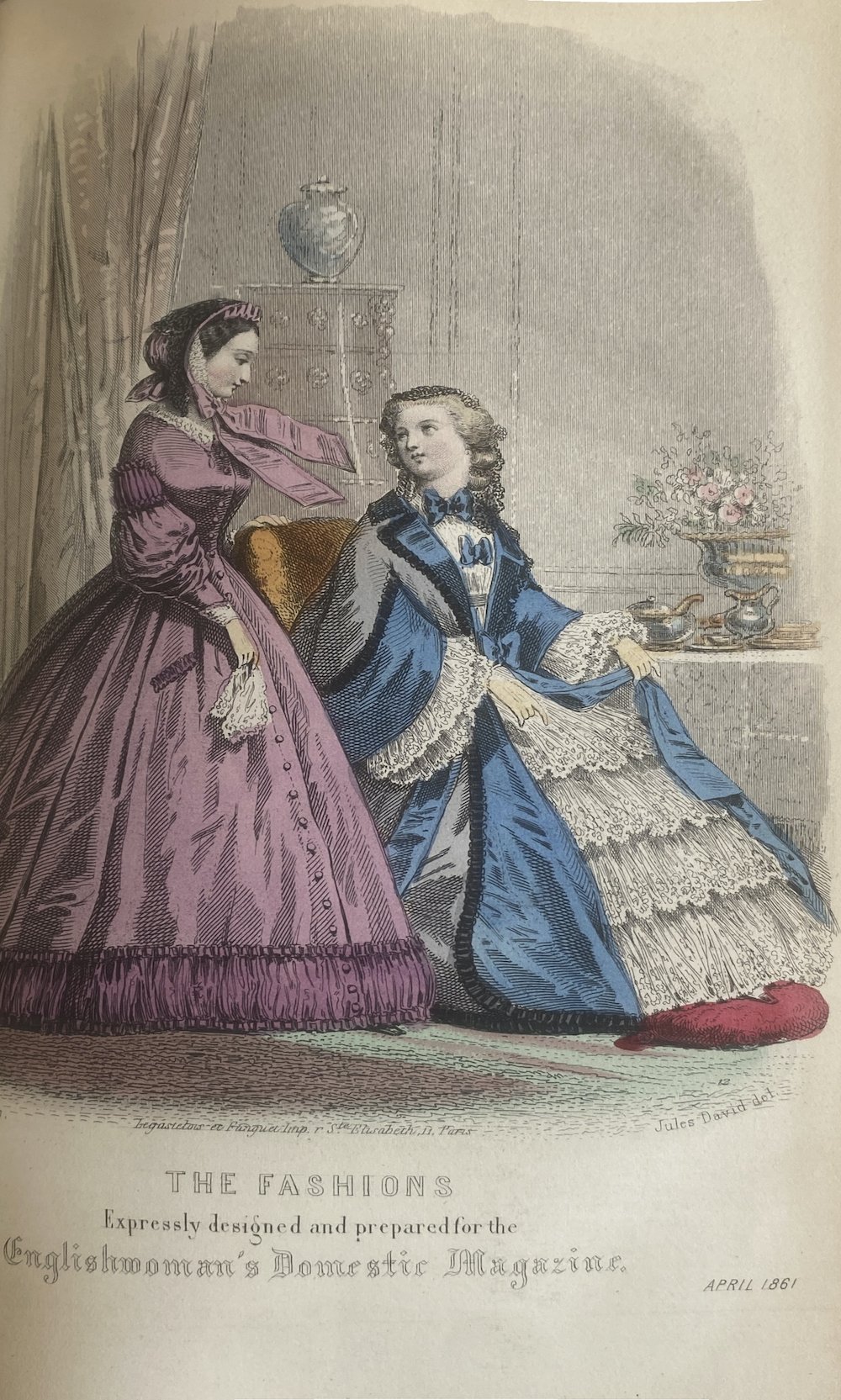
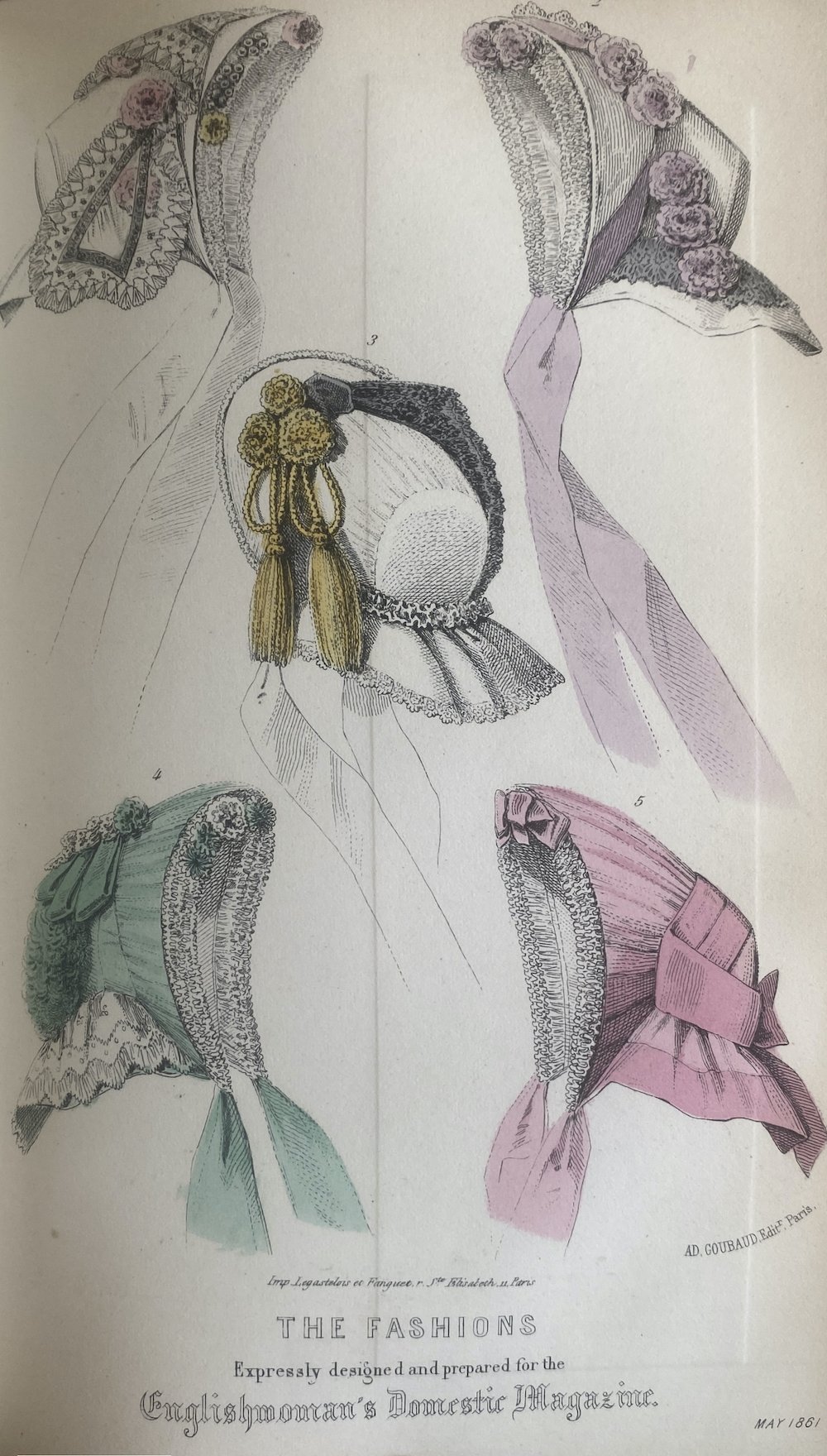
The Englishwoman’s Domestic Magazine 1861
This page is from the third volume of the magazine and shows that the dresses still carried on the styles of the previous decade.
The skirts use the crinoline cage to create the wide shaping of the dress while having a tight bodice.
This image presents day dresses as the neckline is high compared to what the evening dresses would have.
1860s
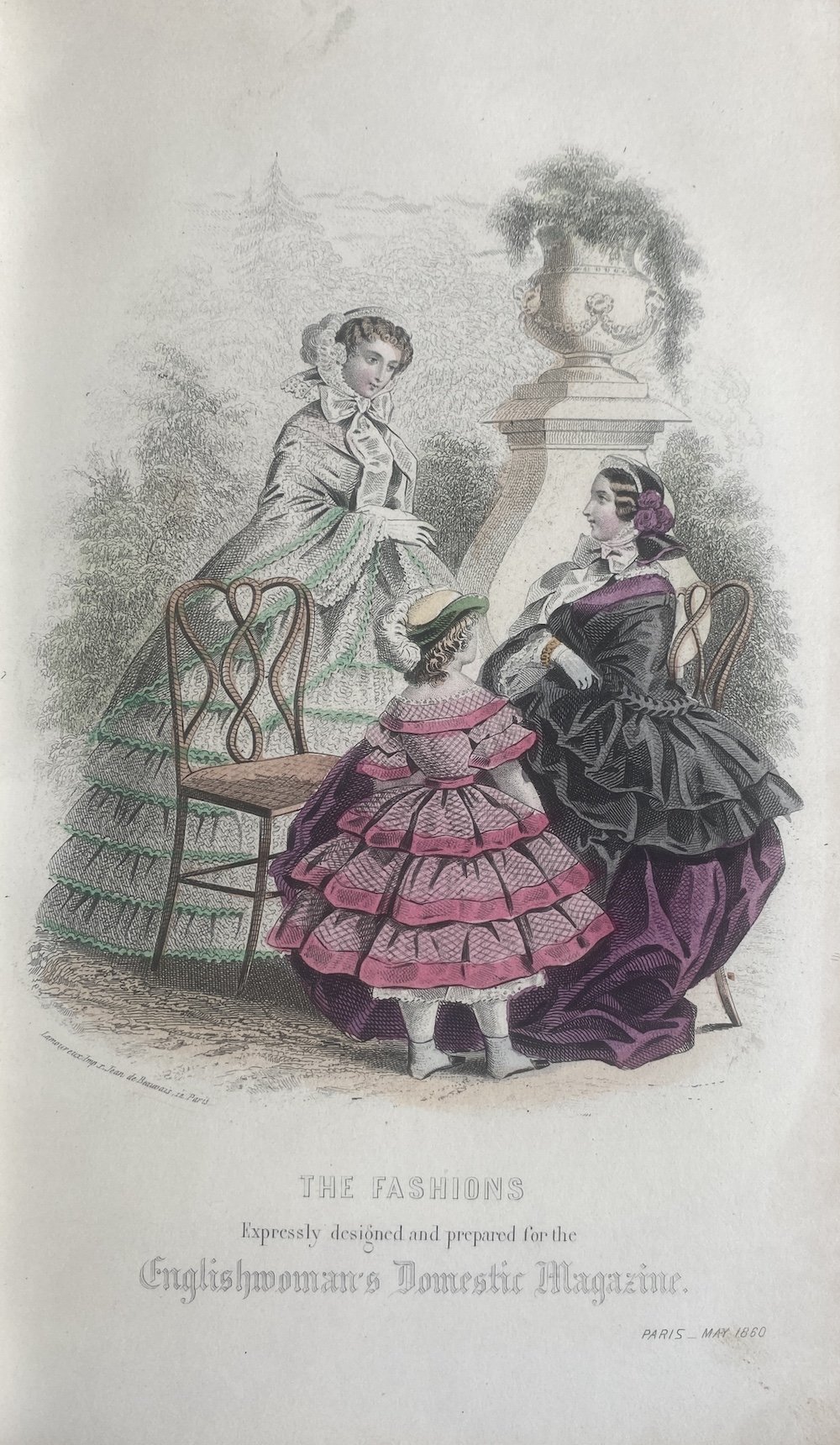
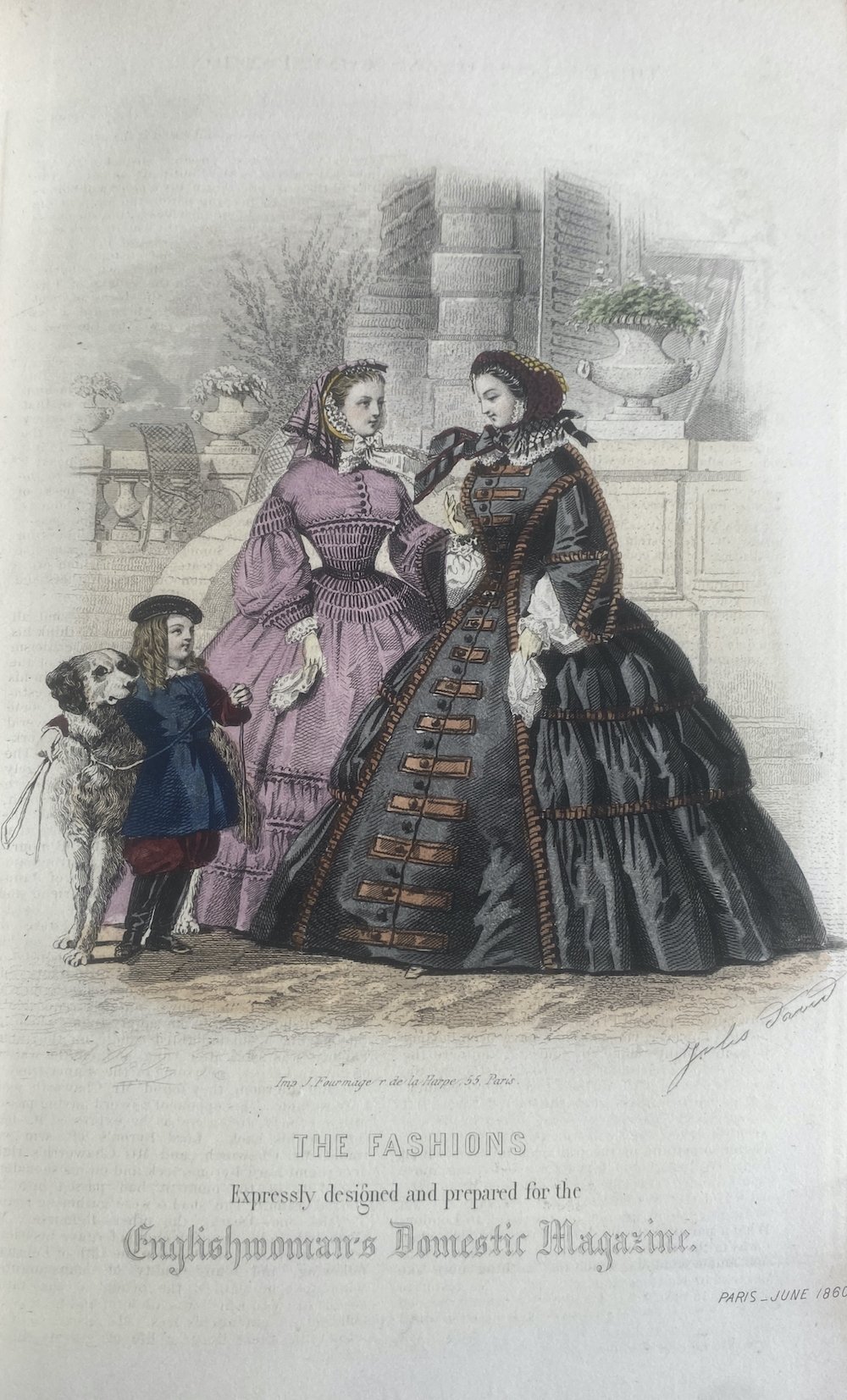
By this decade, the skirts became flatter in the front, while still being flared and shaped in the back and towards the hem.
Later in the decade that the front of the skirt flattened, only flaring out at the back, making a more triangular and conical shape.
By the late 1860s, the crinoline cage had been by the bustle. This is what was used to create the shape of the flatter front but flared back silhouette that became popular; this stayed the way for shaping skirts until the 1870s.
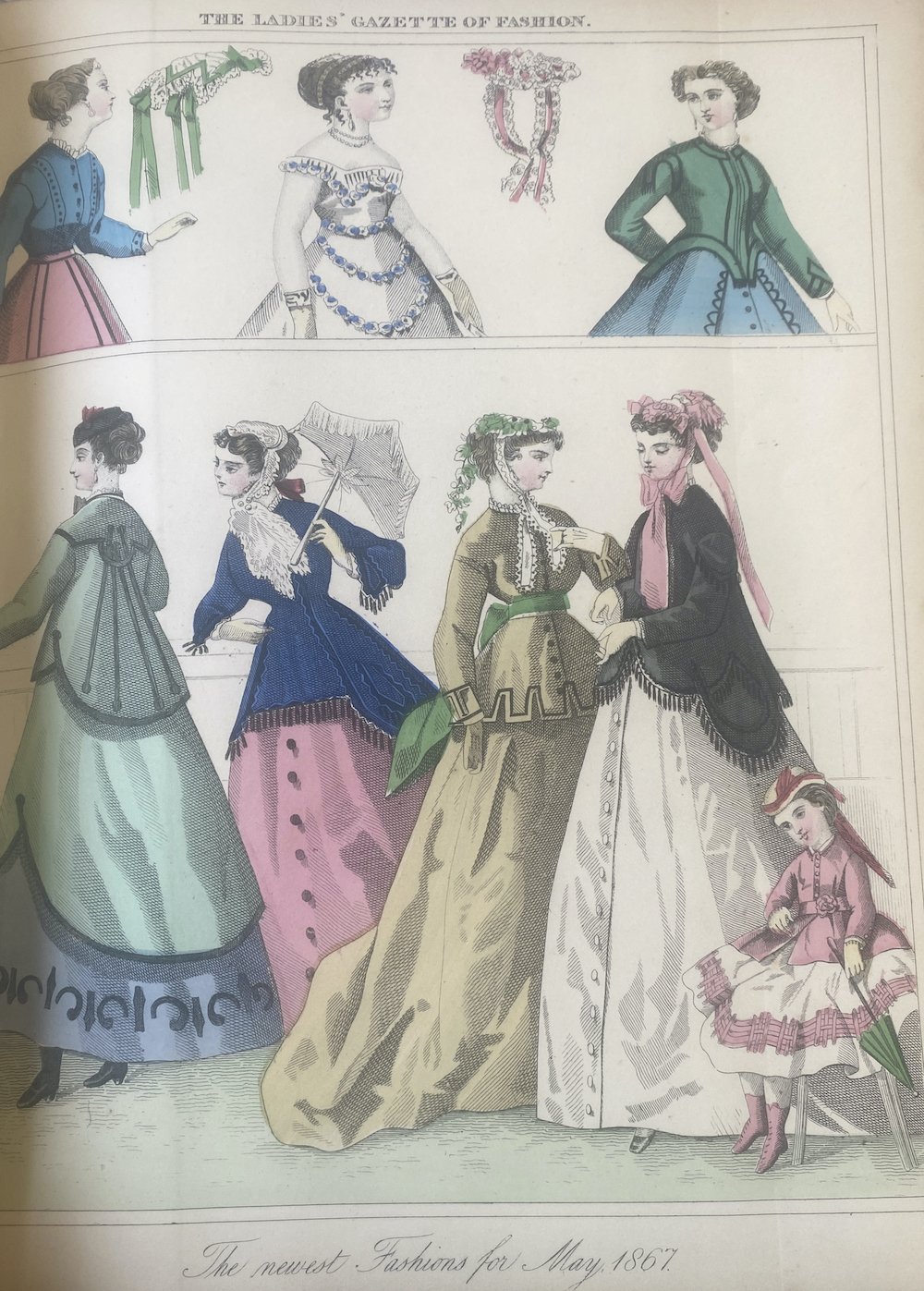
The Ladies’ Gazette of Fashion 1867
By this point in the century, the hat had been replaced by the bonnet which can be seen in this illustration in the magazine.
Parasols and lace gloves can also be seen as accessories for the month of May and in the summer months as during the Victorian era, the upper classes took many measures to avoid a sun tan, which was associated with being poor and working a lot outside.
The emerald green shades in this fashion palette were created through the use of arsenic. Green was a difficult colour to create, produce and maintain in clothing until 1775 when Swedish chemist Carl Sheele mixed sodium carbonate with arsenious oxide to create ‘Scheele green’ or ‘arsenic green’.
In 1814 a Germany company used this discovery to create a new shade, ‘emerald green’. This shade became all the rage in fashionable dresses despite the dangerous effects of the dye, including sores and ulcers on the skin.
Sweating increased the release of the arsenic, resulting in it sinking into the blood stream (causing hair loss, vomiting of blood, and liver and kidney failure). Reports of arsenic poisoning appeared in the 1870s but continued to stay a popular way of getting the perfect green shade until the late 1880s.
1870s
The bustle was a distinct undergarment during the Victorian period. A gathered overskirt over the back of the main skirt became an important feature in this decade.
The use of sewing machines made it more possible for pleated trimming to be attached in larger quantities, providing layers to the skirts.
The evening dresses were only slightly different to the day dresses, sporting a lower neckline still while also being almost sleeveless.
In this decade, a more fitted, natural style came about but didn’t last very long, and became narrower and more figure-hugging. The bodice lengthened over the hips adding to the ‘natural form’ style of the time.
While the volume of the skirts decreased, they also became more expansive by having trains fanning out behind.
The ruffles, lace and silk flowers carried on through to this decade to decorate the skirts of the everyday dress.
Women generally wore their hair up with this natural styling to aid the tightly fitted sleeves and add to the slim silhouette style.
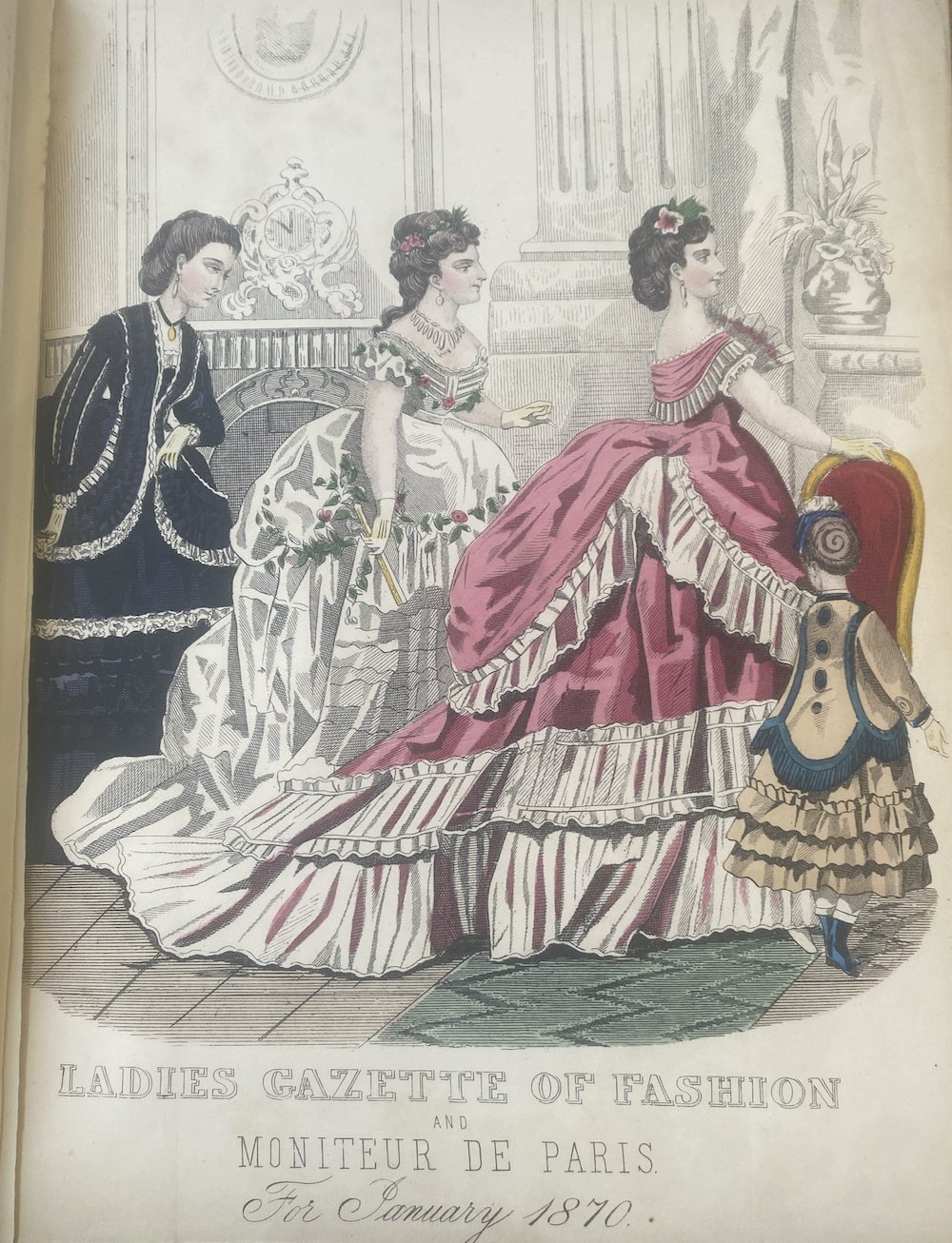
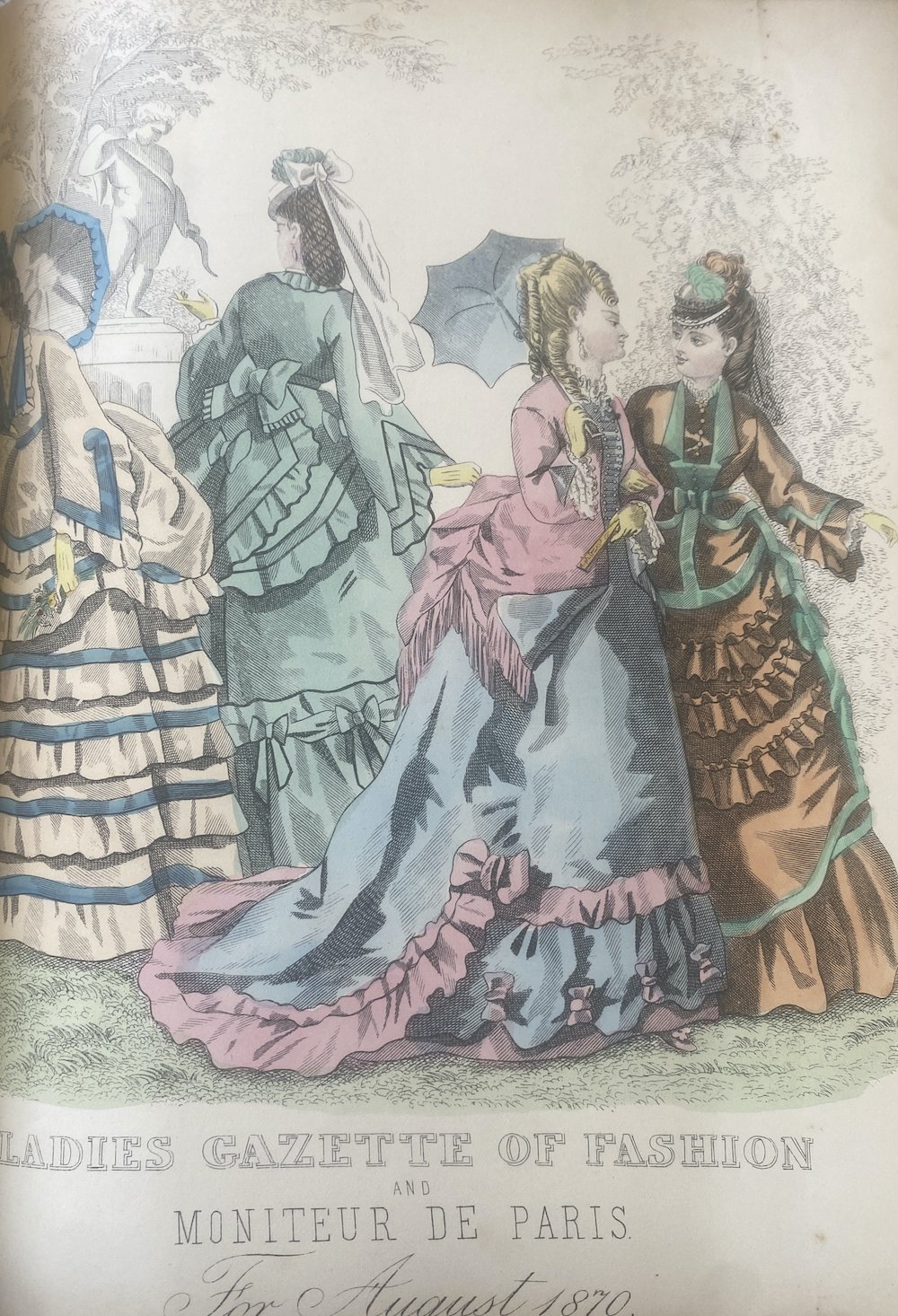
The Ladies’ Gazette of Fashion 1870
The dresses of this era are shown through in the fashion content in the magazines of the time, the gathered overskirts at the dresses were the style of the decade.
Each lady's overskirt allowed more freedom in the styling in the dresses due to adding an extra layer and decoration to the elaborate style.
The use of ruffles can be seen largely being used in the styling of the August dresses in this volume of the periodical.
Despite it being August, long sleeves were still in fashion alongside the parasols to once again prevent any kind of suntan.
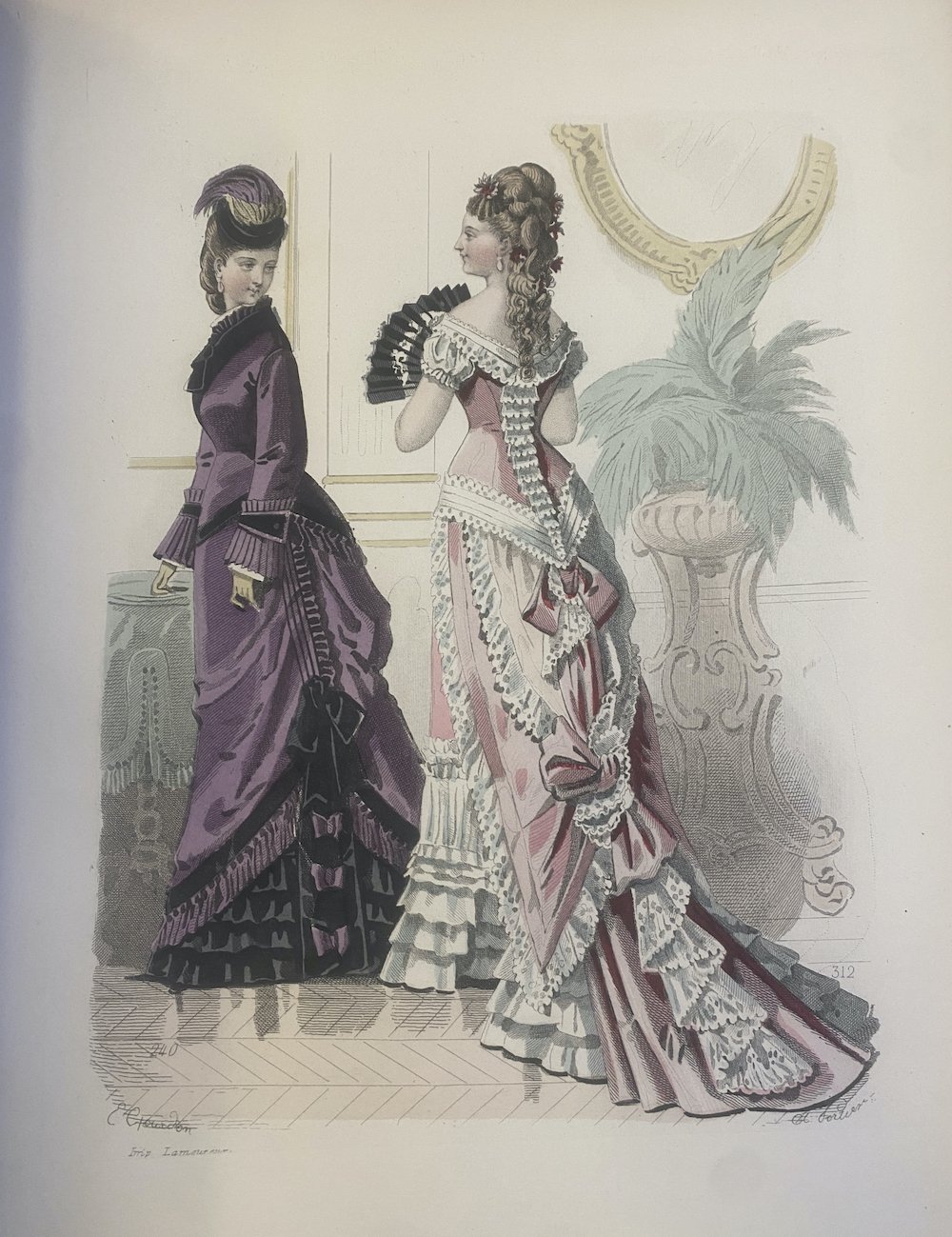
The Ladies’ Gazette of Fashion 1877
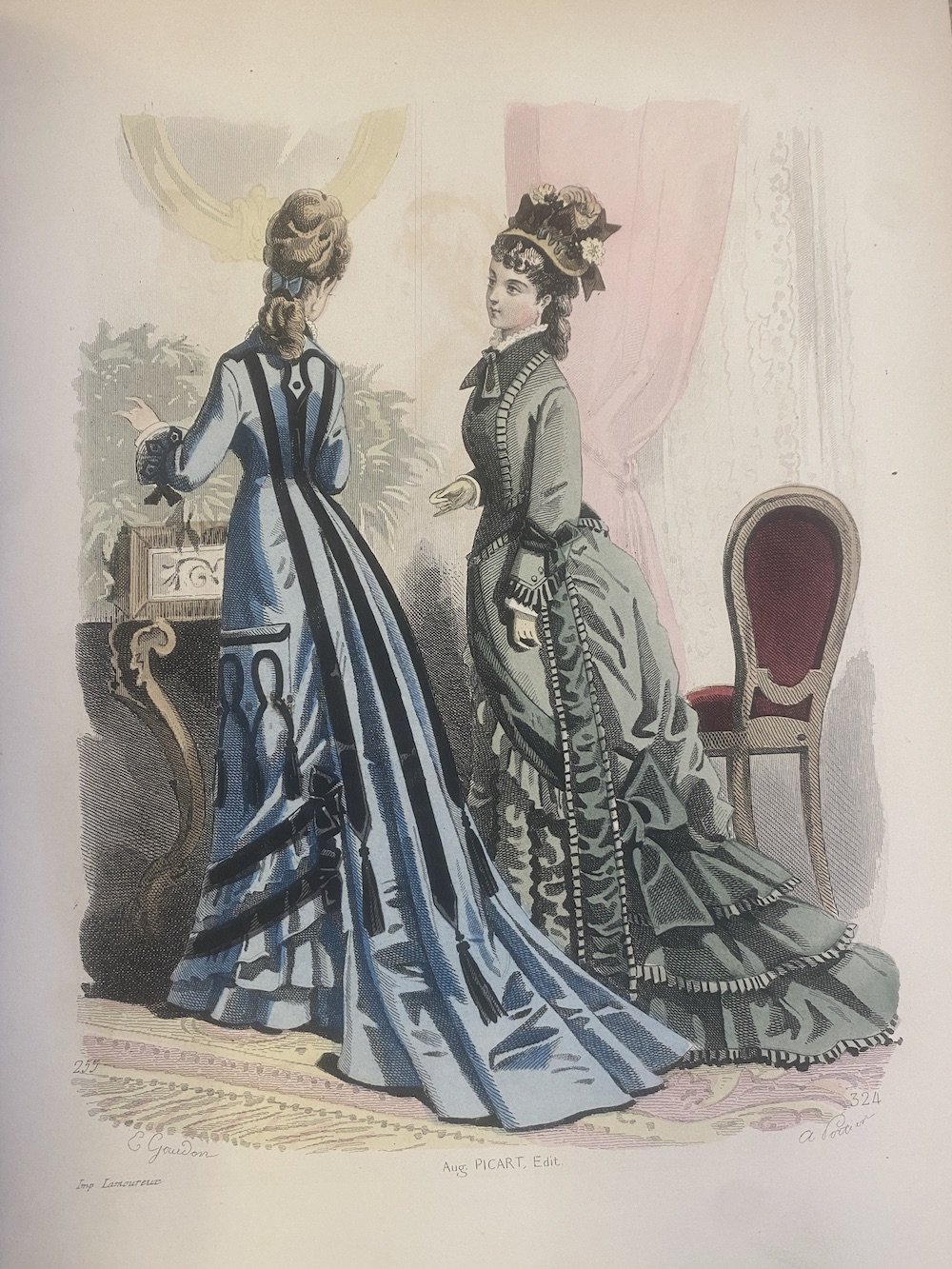
This illustration in this later edition of the periodical shows the fashion style evolving and moving into the next decade.
The trailing skirts still stayed with ruffled overskirts though were not as voluminous. The dresses also had a more natural look to them with the underdresses and bustles becoming less extensive, giving a more natural form to the dresses.
1880s & 90s
Across these two decades in the Victorian era, there were many influences from other cultures’ art and fashion styles; including Japan and Europe. In addition, there were many influences from the Art Nouveau movement (c.1890-1910) which was strongly influenced by Japanese art. When the chrysanthemum was brought to Europe, it became a popular motif embroidery on clothing.
The second bustle era came about around 1883. This was more ‘architectural’ through it being a rounded skirt that is flat at the front but protruding more in the back; the bustle was there to support the weight of the skirt’s overdress. A ‘New Phantom’ bustle did come about in 1884 which consisted of steel wires that were collapsible when the wearer sat down, making the bustle more comfortable and adaptable to wear.
While an unnatural look came into fashion in the 1890s, the angular shapes of the previous decades weren't in favour and fashion had moved onto a simpler, less restrictive look. This can be seen as being connected to the ‘New Woman’ movement, a movement where a feminine, social and cultural shift challenged the strict gender roles of the time, being an important concept in feminism and the turn-of-the-century. The unnatural look was created through the mono-bosom, an S-curve with a large pigeon breast achieved through layers of ruffled corset covers or blouses. It was the styling of the clothes to give it the unnatural look rather than the body itself.
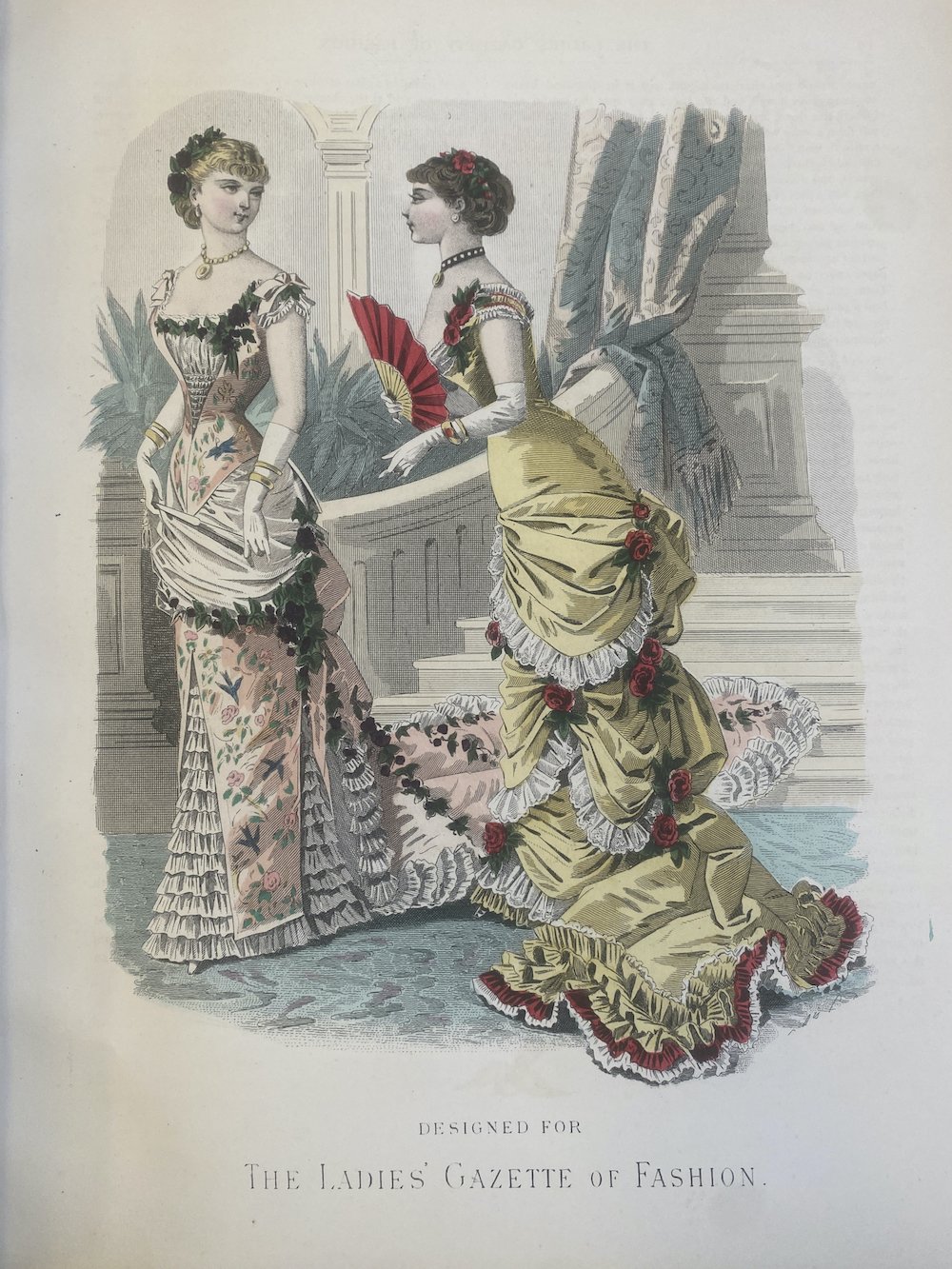
Ladies Gazette of Fashion 1885
This page spread in the magazine presents the influence that other cultures and arts had on the Victorian era.
The cherry blossom in the background relates back to Japanese influences and the Art Nouveau movement. The second bustle era was in full swing by this point and was needed to support all of the overskirts that came together to create the layered look at the back of the dresses.
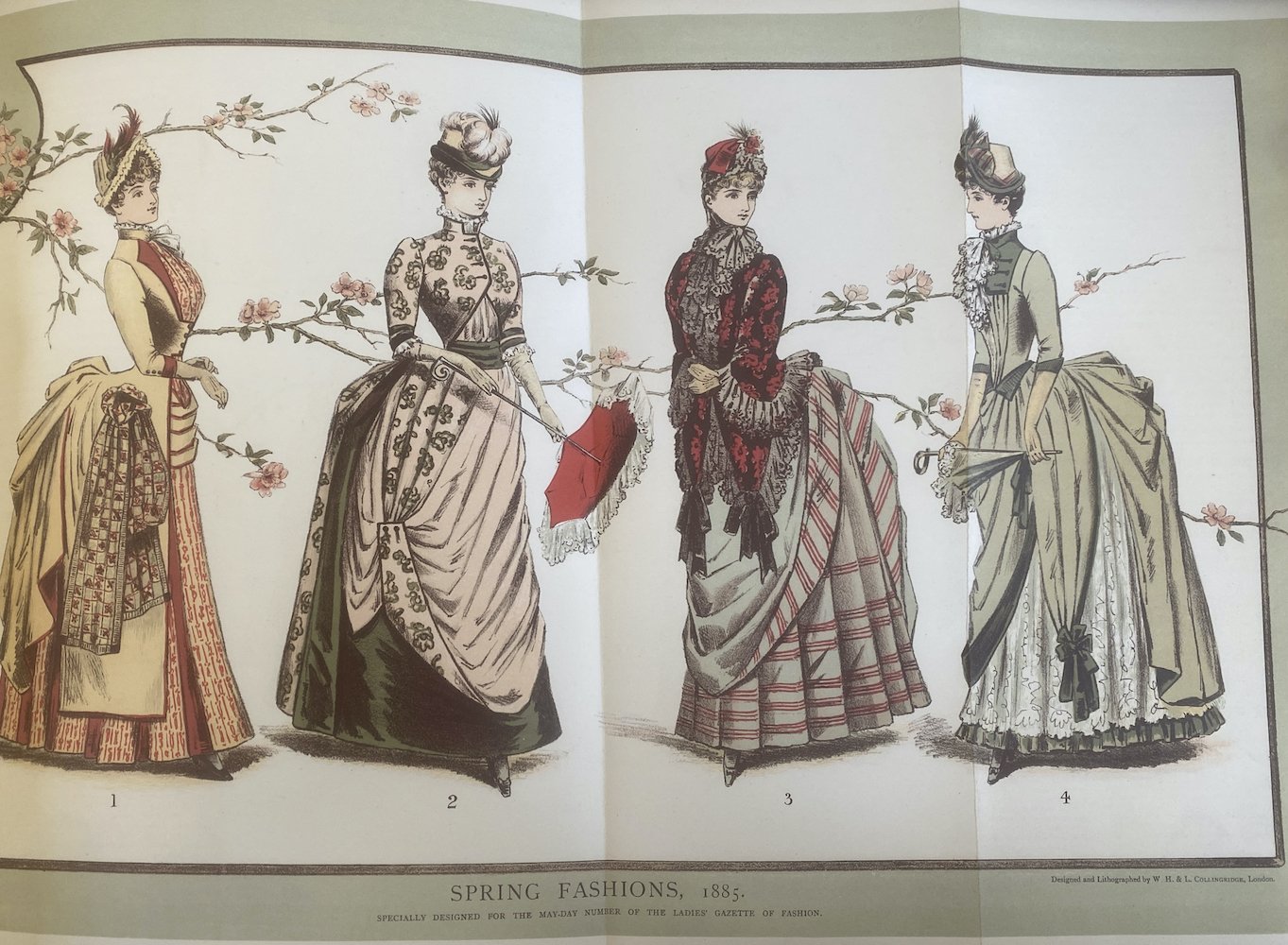
This page spread also shows a lot more patterns on the dresses compared to previous decades within this era of fashion. This could also be because of the larger uptake in art movements and cultures having that influence on fashion and styles.
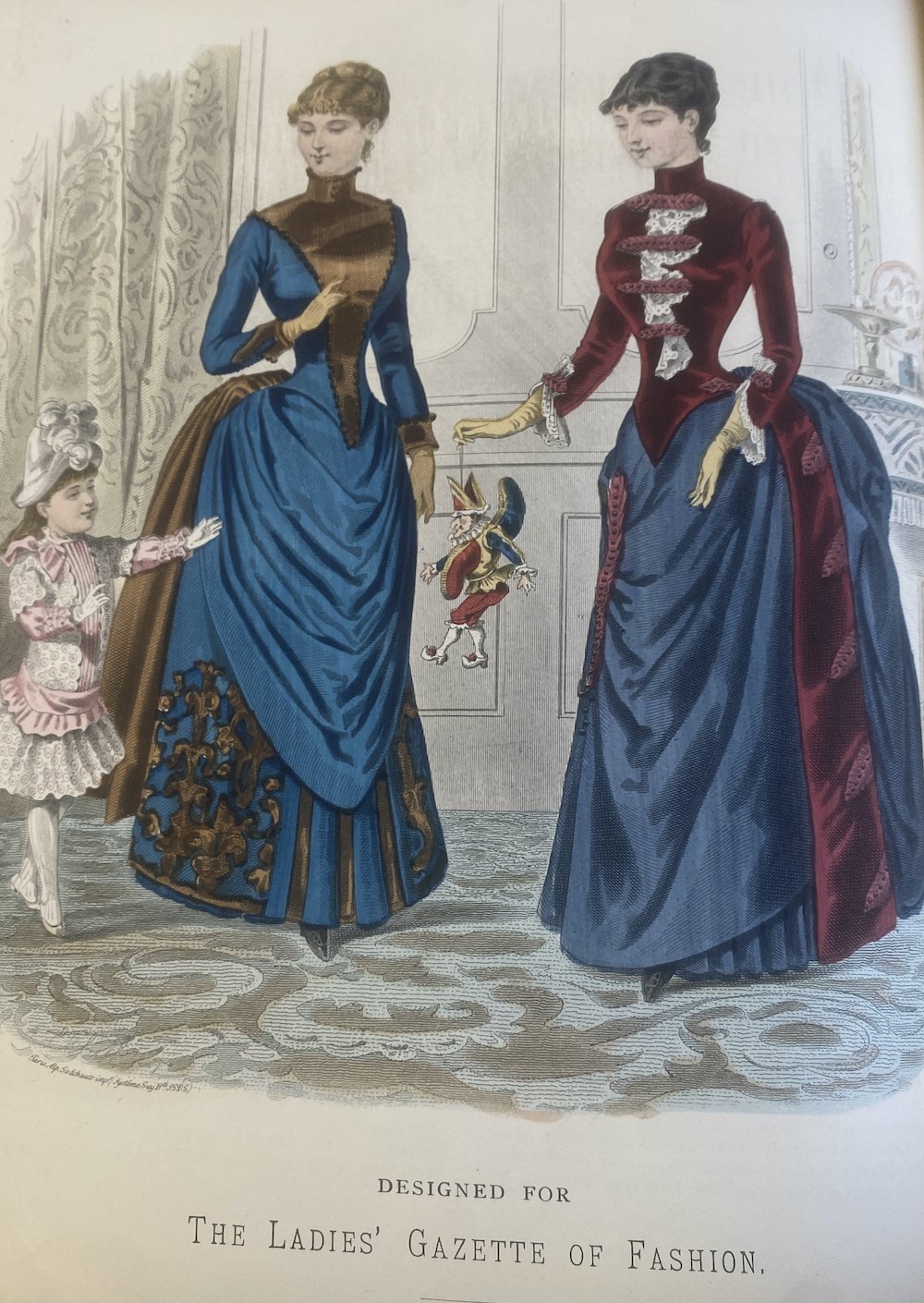
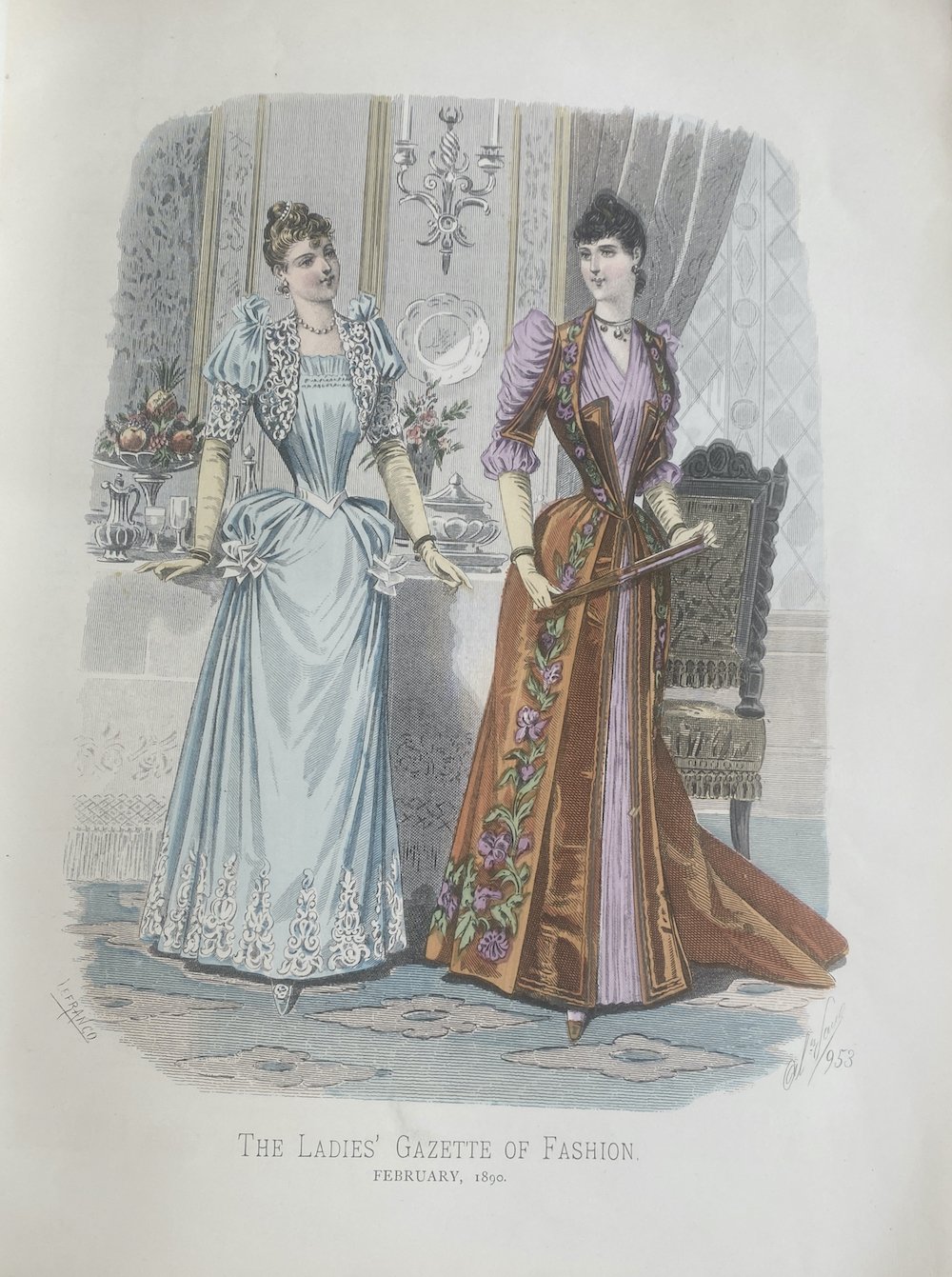
Ladies Gazette of Fashion 1890
The ‘walking dress’ was typical of mid-1890s day clothes which had large bell-shaped sleeves, a tight bodice and a smooth flared skirt creating an unnatural look along with the mono-bosom.
While the shapes weren’t as angular and constructed as the previous decades of fashion, they still were cinched tightly around the bodice to maintain the unnatural figure that became the style of the 1890s.