

DOMESTICITY

Domesticity is all about married life, the ways of the home and the gender roles within society.
The typical marriage life involved the woman staying home, looking after the children and tending to the house ready for the married, working man to come home from a day of earning to provide for the family.
This was the reign of Queen Victoria who posed as a strong female character in periodicals as well as to society itself. Her marriage presented stability and domestic virtue which was reflected through society.
Queen Victoria was known as ‘the mother of the nation’ embodying the home as the typical domestic space for women to run.

The Working Household
Women were regarded as possessions of their families as they were the ones in the home cooking, cleansing, mending clothes and generally caring for members of the household, husbands, children and extended family members. Women of the wealthier classes did not carry out these tasks themselves, but they were expected to direct their servants in these domestic duties to maintain a respectable home.
Before the industrial revolution, housework required a lot of physical effort. For instance, hard floors needed regular sweeping to stay clean and until the Victorian era, carpets were seen as more of a luxury.
People with more money tended to strew reeds, or weave them onto mats, to cover the hard floors; these still needed to be changed regularly. Linens needed to be smoothed with glass weights or smooth stones before the invention of the iron.
There were not many labour-saving devices at the beginning of the Victorian era but as the industrial revolution came into full swing by the 1840s, more appliances were available to aid in housework. Carpet beaters, feather dusters and sculleries all remained in homes after the industrial revolution, however.
Sculleries were a container made for washing clothes and were turned with a dolly (wooden pole with a stool) to wash the clothes. A metal plunger was also used to wash the clothes instead of a dolly. These still required a lot of physical exertion.

The Englishwoman’s Domestic Magazine
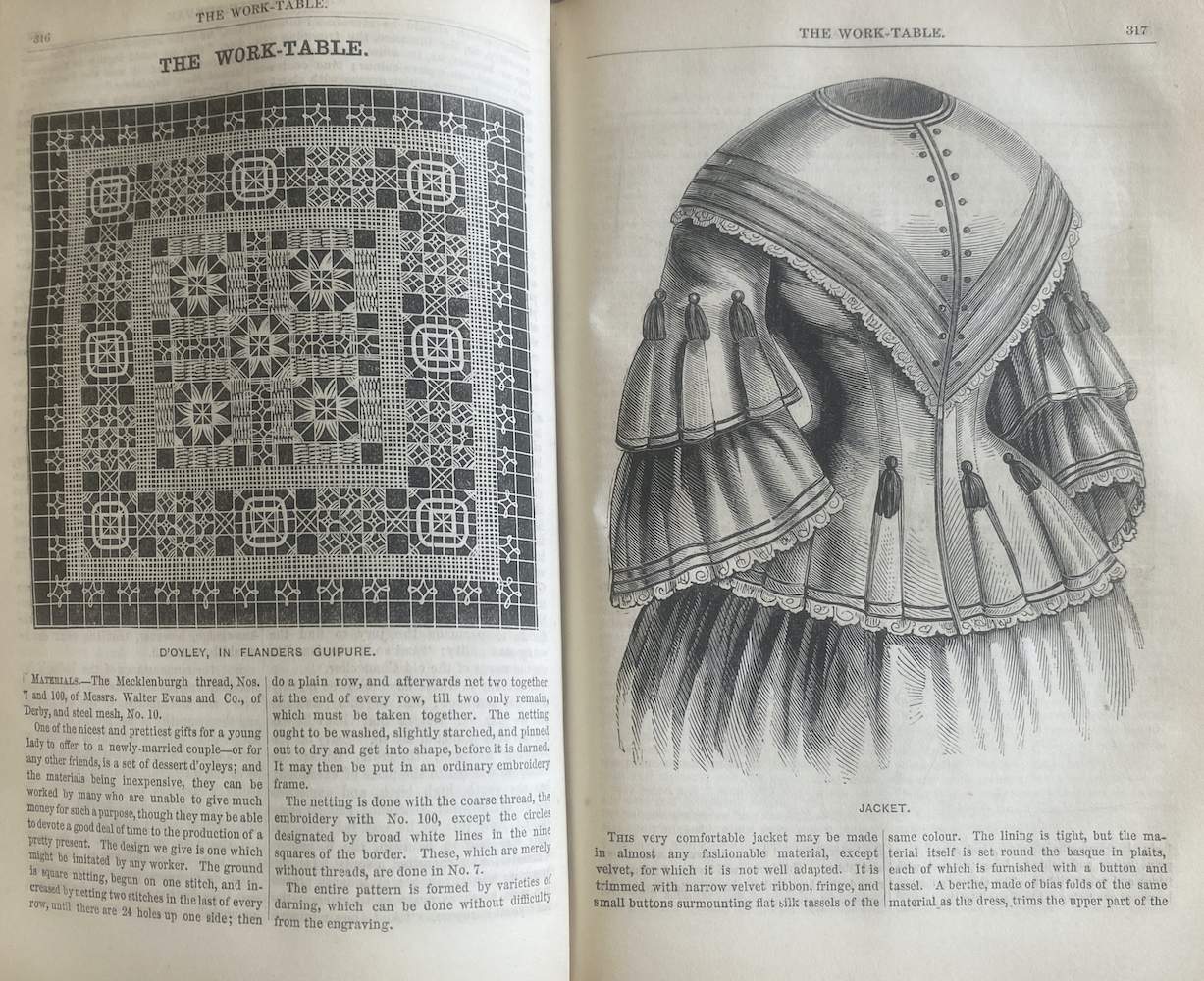
This periodical had a section called ‘The Worktable’ which gave advice from sewing patterns and embroidery designs to accessories and trinkets for the home. ‘The Worktable’ would describe activities for women to do over a period of time, in other words, a project to keep them busy.
Flower arrangements and gardens were also big topics within the magazine. The magazine was released monthly and would base the content on flowers of the month and explain how to tend them in the colder months.
‘The Kitchen Garden’ was also a regular feature in the EWDM and it explained what vegetables were best to grow in particular months and how to use them in meals at specific times of the year. This would have been helpful at the time as vegetables and meats were not as well preserved as they are today. Although the Victorians had iceboxes to preserve items a bit longer, they were not as effective as the refrigerators and freezers that we have today.
The magazine was a guidebook on how to be the perfect housewife.
Motherhood
The centre point of domesticity in this period was the mother and children. It was the ‘sweet vocation’ as women spent more time with their children compared to previous decades.
Breast-feeding, educating and playing with their children was more typical in this era. Women more emotionally connected to and bonded more with their children, with middle-class women being the ones to give constant attention to their infants instead of, for example, nursery maids or governesses.
Motherhood was an affirmation of their identity. Motherhood confirmed that the married woman had fulfilled their female and womanly virtue. A woman with no children was viewed as abnormal or even a failure in their role of being a woman.
This article in the Illustrated Household Journal from 1880 presents a story that a mother would typically read to their children, offering another way of connection to their infants while also allowing the mother to indulge in a magazine that they would get monthly.
However, the industrial revolution encouraged women and mothers to evolve with the changing times. Women in the northern area of the country were commonly seen working during the industrial revolution in order to make money for their families.
Around 750,000 working women at the time were also mothers, spending time away from their children, working in factories instead.
The revolution caused women to lose control over their working lives, the separation between mother and child dictated on who worked on what and where they conducted this work, eventually pushing women out of the public and back into the domestic sphere.
Some work allowed working women to bring their child to work but was only influenced in factories after the mothers’ desire of care for their infants and their inability to pay for separate childcare due to them being working-class. In this case it was noted that children being in the factories, despite the health issues surrounding it, was better than them staying home with no childcare because of the families’ limited funds.
Marriage
Marriage presented a woman’s growth in responsibility and maturity that led them towards motherhood and their fulfilment in womanly virtue. While acquiring this responsibility, women did not gain any control over their property.
Real property, as in freehold land, was passed to the husband in marriage but would not be disposed of without the woman’s consent. On the other hand, personal property owned by women, such as money and personal belongings, passed to the husband’s complete control in marriage. To part with these personal properties, the wife would have to gain the husband’s consent, with him having the power to overrule. Avoiding these rules meant agreeing to the marriage settlement under equity law.
To further this, the Married Woman’s Property Act in 1870 meant that women could keep their personal property that were acquired after marriage; with a further act in 1882 allowed women to keep what they owned at time of marriage.
This article in The Ladies Gazette of Fashion in 1870 states that “a husband shall not be liable for the debts of his wife contracted before marriage, but the wife can be sued for any such debts as if she were unmarried”
“The earnings of any married woman acquired by her passing of this act, in any employment in which she is engaged separately from her husband ... shall be for her own separate use independent of her husband”.
This shows the progression in women’s property ownership with women gaining more power and control over themselves, their possessions and eventually their vote.